


Armenian wedding traditions represent one of the world’s oldest continuous wedding cultures, with customs dating back over 1,600 years. These celebrations beautifully blend ancient rituals symbolizing fertility, prosperity, and family unity with joyous festivities that create unforgettable experiences for everyone present.
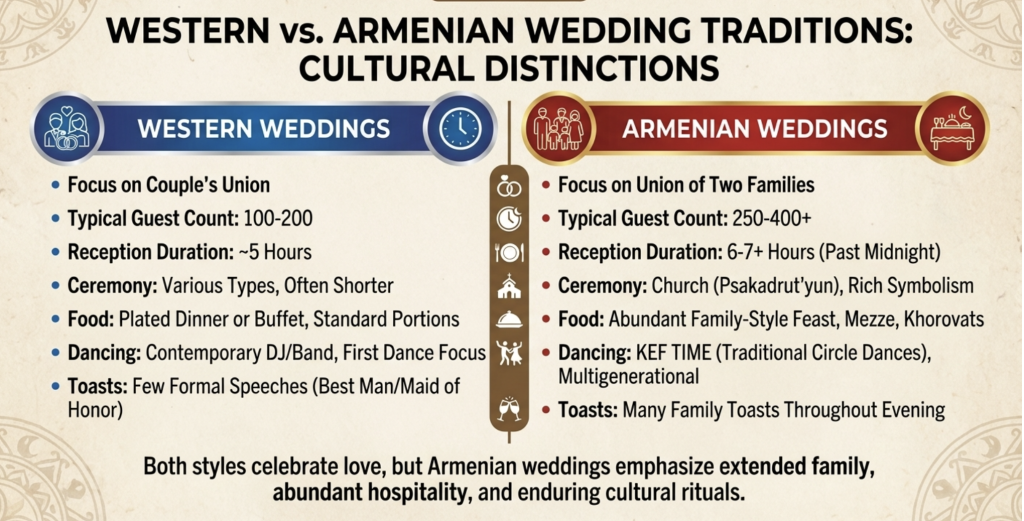
Unlike many Western weddings focused primarily on the couple, Armenian weddings celebrate the union of two families. Every tradition carries deep symbolic meaning, from the lavash bread placed on newlyweds’ shoulders to the energetic kef time dancing that brings generations together. These aren’t empty gestures or Instagram moments; they’re meaningful rituals connecting modern couples to centuries of heritage.
Whether you’re Armenian planning your wedding, marrying into an Armenian family, or simply curious about this rich culture, understanding these traditions helps you appreciate their significance and properly honor them in your celebration. This guide explores the essential Armenian wedding customs you’ll encounter, explains their symbolic meanings, and provides guidance for incorporating them authentically.
Let’s discover what makes Armenian weddings so special.
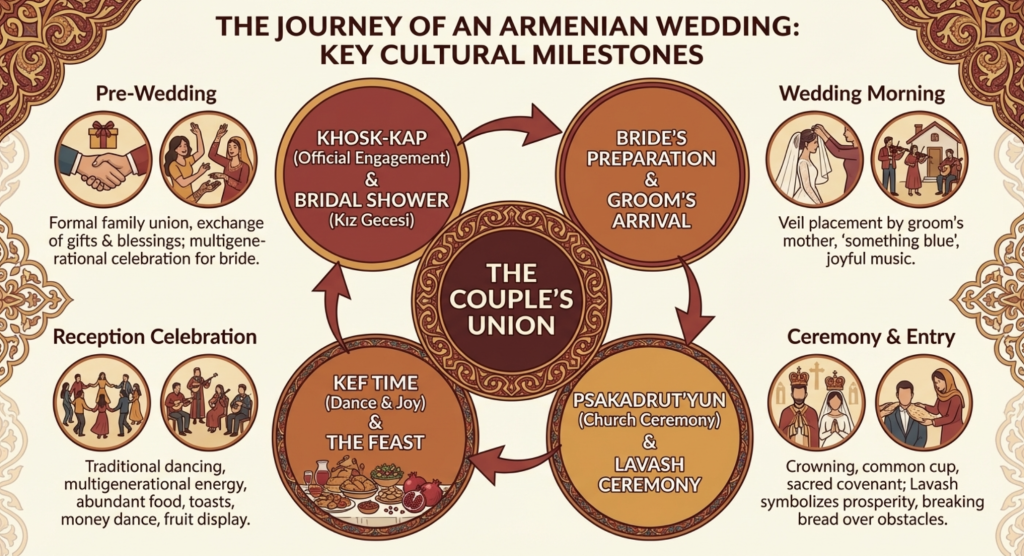
Pre-Wedding Traditions: Building to the Celebration
The Khosk-Kap (Official Engagement)
Before the wedding comes the khosk-kap, the formal engagement ceremony where families officially unite. Traditionally, the groom’s family visits the bride’s family bearing gifts, including fruits, flowers, sweets, and often jewelry or a family heirloom.
What happens: Both families gather, often with extended relatives present. The groom formally asks the bride’s father for her hand. After receiving blessings, families exchange gifts and toast with Armenian cognac or wine. This ceremony establishes the familial bond that will strengthen at the wedding.
Modern adaptations: Many couples host khosk-kap as an intimate family dinner at restaurants or homes, maintaining the gift exchange and blessing elements while simplifying logistics. Some families combine this with the engagement party, creating one larger celebration.
Cultural significance: The khosk-kap emphasizes that Armenian marriage unites families, not just individuals. It gives families time to know each other before the wedding day rush.
The Bridal Shower (Kız Gecesi)
Armenian bridal showers blend American shower traditions with cultural elements. Female relatives and friends gather to celebrate the bride with games, food, and gifts.
Traditional elements often included:
- Henna ceremony (in some families)
- Traditional Armenian music
- Sweets and pastries
- Blessing from elder women
- Advice sharing from married women
What makes it special: Armenian bridal showers often span multiple generations, with grandmothers, mothers, and young girls all celebrating together. This multigenerational gathering passes wisdom and welcome from older women to the bride.
The Bachelorette and Bachelor Parties
Modern Armenian couples often have separate bachelor/bachelorette parties following American traditions. However, some families maintain the traditional Kız Gecesi (girls’ night) and Bekarlar Gecesi (bachelors’ night) with cultural elements, traditional music, and family involvement rather than typical Western party atmospheres.
Wedding Day Traditions: Sacred Rituals and Symbolism
The Bride’s Morning Preparation
Armenian brides traditionally dress surrounded by female relatives. This intimate time features:
The veil placement: Traditionally, the groom’s mother or another respected married woman from his family places the veil on the bride, symbolizing her transition into the groom’s family. This tender moment often becomes emotional as it represents the bride gaining a second mother.
The “something blue” equivalent: Armenian brides often wear a small blue ribbon or accessory to ward off the evil eye, an ancient tradition protecting against jealousy and bad luck.
The wedding shoes: Some families place coins in the bride’s shoes for prosperity. Others write the names of unmarried female friends on the bottom of wedding shoes; those whose names fade first will marry next.
The Church Ceremony (Պսակադրություն – Psakadrut’yun)
Armenian Orthodox wedding ceremonies contain deeply spiritual symbolism. If you’re having a religious ceremony, expect these elements:
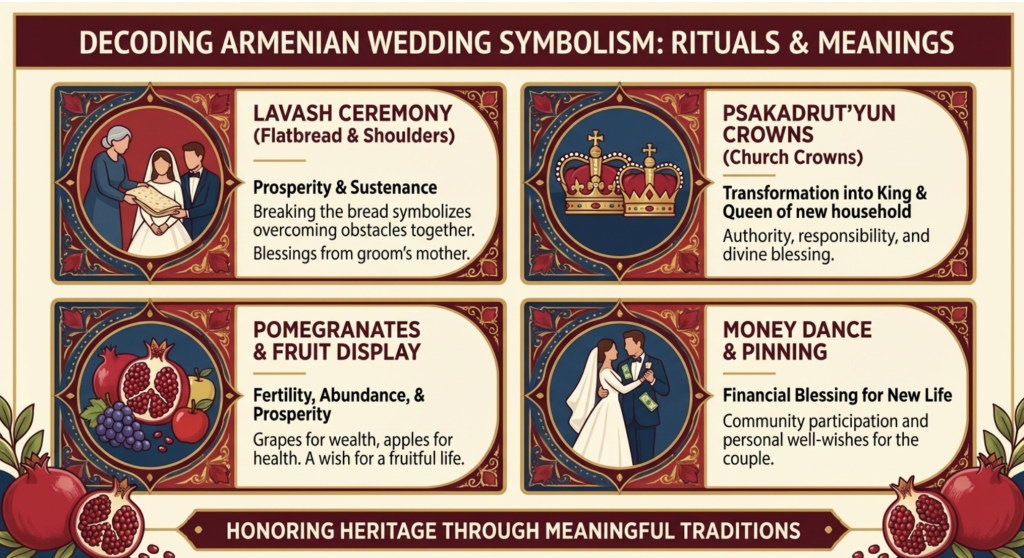
The crowning (Psakadrut’yun): The priest places crowns on the couple’s heads, symbolizing their transformation into king and queen of their household. This powerful moment represents their new authority and responsibility.
The common cup: The Bride and groom drink from the same cup of wine, symbolizing shared joys and sorrows. They will face life’s sweetness and bitterness together.
Walking around the altar: The couple circles the altar, often three times, representing their eternal journey together. Some interpret it as the Holy Trinity blessing their union.
Joining hands: The priest binds the couple’s hands together with his vestment, physically demonstrating their union.
Biblical readings and blessings: Specific passages emphasize marriage as sacred covenant, family building, and divine blessing.
Duration: Armenian Orthodox ceremonies typically last 45-60 minutes, longer than standard Western ceremonies but deeply meaningful for families.
The Lavash Ceremony (Լավաշի Ավանդույթ)
Perhaps the most visually striking Armenian wedding tradition is the lavash ceremony, which occurs as newlyweds enter their reception.
How it works: The groom’s mother greets the couple at the entrance, holding a piece of traditional lavash (thin flatbread) on a tray. She places the lavash on the groom’s shoulder, then the bride’s shoulder. The couple breaks the lavash with their shoulders to see whose piece is larger.
The symbolism:
- Lavash represents prosperity and sustenance, blessing the couple with abundance
- Breaking the bread symbolizes the couple breaking through life’s obstacles together
- Some believe whoever gets the larger piece will be the household “boss,” adding playful competition
- The act represents the couple’s entry into their new life together
Why it matters: This simple yet powerful tradition immediately involves both families, particularly highlighting the mother-in-law relationship. The groom’s mother welcomes her new daughter, establishing connection and blessing.
Modern variations: Some venues create elaborate lavash presentations with decorative trays. Others keep it simple and traditional. Both approaches honor the custom’s essence.
The Sword Dance
At some Armenian weddings, particularly those honoring specific regional traditions, a ceremonial sword dance occurs. Two people hold a sword over the couple’s heads as they enter, symbolizing protection and the cutting away of negativity.
Regional variations: This tradition is more common in certain Armenian regions and diaspora communities than others. It’s not universal but remains meaningful where practiced.
Reception Traditions: Joy, Dance, and Celebration
Kef Time (Քեֆ): The Heart of Armenian Celebrations
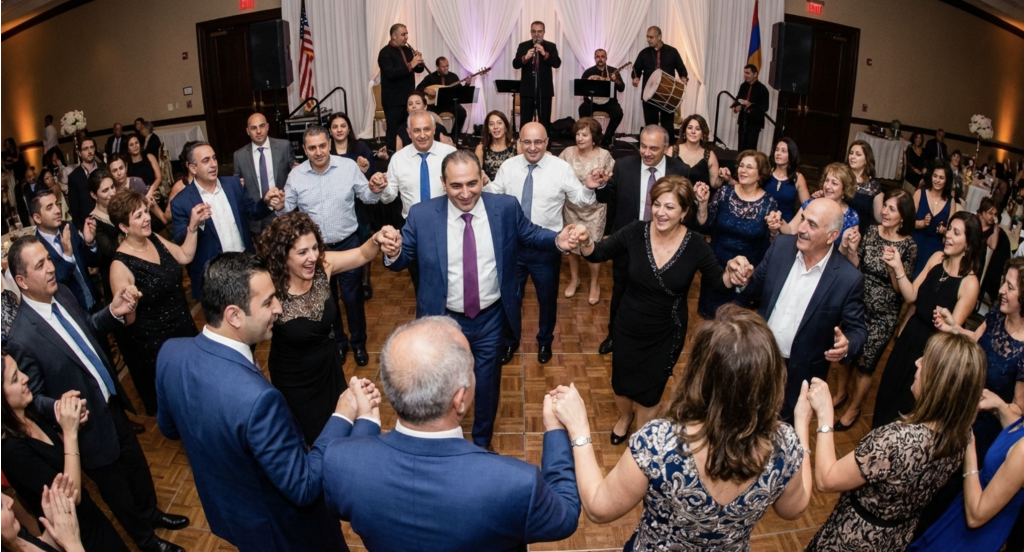
If there’s one tradition that defines Armenian wedding receptions, it’s kef time. This energetic celebration period features traditional Armenian music and dancing that brings everyone from toddlers to grandparents onto the dance floor.
What is kef? The word “kef” roughly translates to “pleasure” or “good times.” During kef time, the band or DJ shifts entirely to Armenian music, playing traditional songs everyone knows and loves.
Traditional Armenian dances you’ll see:
Tamzara: The signature Armenian group dance. Dancers hold hands in a line or circle, performing synchronized steps. New dancers easily join by grabbing the line, creating an ever-growing celebration.
Yarkhushta: A men’s dance showcasing strength and skill. Men form competing lines, performing aggressive, martial-style movements. This powerful dance displays masculinity and friendly competition.
Kochari: Another traditional circle dance with variations across Armenian regions. The leader improvises while others follow, creating spontaneous joy.
Shalakho: A solo dance where individuals (traditionally men) showcase skill through fast footwork and dramatic movements. Often performed during emotionally charged moments.
Why kef time is special: This isn’t performance; it’s participatory joy. Your 90-year-old grandmother dances next to your five-year-old niece. Everyone knows the steps, passed down through generations. The energy is electric, the connection palpable.
Duration: Kef time can last 45 minutes to over an hour, depending on crowd energy and band stamina. At Armenian banquet halls in Los Angeles, experienced staff and musicians know exactly how to time this portion for maximum impact.
Live bands vs. DJs: Traditional kef time works best with live Armenian bands who feel crowd energy and adjust tempo accordingly. However, skilled DJs with extensive Armenian music libraries also create wonderful kef time experiences. Many couples use both: live band for kef time, DJ for contemporary music.
The Money Dance
Armenian weddings feature enthusiastic money dances where guests pin cash to the bride and groom’s clothing while dancing with them. This tradition serves multiple purposes:
Financial blessing: Money collected helps the couple start their married life with financial cushion.
Celebration participation: Every guest gets a moment to personally celebrate with the couple, offer blessings, and share joy.
Photo opportunities: The visual of a couple covered in bills creates memorable images, though modern couples often collect money more discreetly.
How it works: Guests line up to dance briefly with bride or groom, pinning money to their clothing during the dance. Some families designate helpers to collect money as it’s pinned. Others let it accumulate dramatically before collection.
Modern variations: Some couples prefer monetary gifts given traditionally in cards rather than pinning. Others embrace the tradition fully. There’s no wrong approach; it’s about your comfort level.
Toasts and Speeches (Կենացներ – Kenatsner)
Armenian receptions feature abundant toasts. Unlike Western weddings with 2-3 formal speeches, expect multiple family members and friends to raise glasses throughout the evening.
Traditional toasting order:
- Father of the groom offers first toast
- Father of the bride responds
- Best man and maid of honor
- Godparents (kavor and kavorkin)
- Extended family members
- Close friends
- Spontaneous toasts throughout the evening
Toasting customs:
- Toasts often occur in Armenian, followed by English translation for mixed audiences
- Traditional phrases include “Genats!” (cheers), “Shnorhavor!” (congratulations)
- Armenian cognac or wine is preferred for toasts
- Toasts can be brief or extended, emotional or humorous
- Everyone drinks together after each toast
Why so many toasts? Armenian culture values verbal expression of love, blessing, and good wishes. Multiple toasts ensure everyone who wants to bless the couple publicly can do so.
The Abundant Feast
Armenian weddings are synonymous with abundant, delicious food. Hospitality through generous feeding is core to Armenian culture, and weddings showcase this beautifully.
Traditional wedding menu elements:
Mezze/appetizer spread: Abundant passed appetizers during cocktail hour including dolma (stuffed grape leaves), cheese and herb platters, lavash with spreads, and more.
Family-style service: Main courses often served family-style with large platters shared at tables, encouraging community and abundance.
Khorovats (Armenian BBQ): Grilled meats are wedding staples, including lamb kebabs, chicken, and sometimes whole roasted lamb.
Pilaf: Rice pilaf with vermicelli, butter, and sometimes dried fruits is traditional accompaniment.
Salads and sides: Fresh vegetable salads, roasted vegetables, and multiple side dishes.
Desserts: Often elaborate dessert spreads including baklava, gata (sweet pastry), fruit displays, and wedding cake.
What makes it different: Portions are genuinely generous. Running out of food would bring deep shame to hosting families. Expect abundance that ensures every guest eats well with leftovers.
Dietary accommodations: Modern Armenian venues handle dietary restrictions while maintaining traditional flavors. Vegetarian dolma, halal meats, and gluten-free options appear alongside traditional dishes.
The Fruit Display
Traditional Armenian weddings feature elaborate fruit displays, often as centerpieces or dedicated tables. This isn’t just decoration; it’s cultural symbolism.
Symbolism: Pomegranates represent fertility and abundance in Armenian culture. Grapes symbolize prosperity. Apples represent health. Together, the fruit display blesses the couple with fruitful, prosperous life.
Modern interpretation: Some couples create stunning fruit installations doubling as dessert stations. Others maintain traditional simple displays honoring symbolism over aesthetics.
Extended Celebration Elements
Late-Night Energy
Armenian weddings naturally extend well past midnight. The celebration isn’t rushed; it unfolds organically with multiple energy phases:
- Cocktail hour mingling and appetizers
- Formal dinner and toasts
- Cake cutting
- Kef time and traditional dancing
- Contemporary music and dancing
- Late-night energy surge (often around 11pm-1am)
- Reluctant farewells
Planning consideration: When booking Armenian wedding venues in Glendale, confirm they accommodate celebrations extending to midnight or beyond without excessive overtime charges. Armenian celebrations don’t fit 5-hour time limits comfortably.
Multigenerational Participation
Armenian weddings include everyone from newborns to great-grandparents. This isn’t just invitation courtesy; it’s cultural expectation.
What this means practically:
- Venues need comfortable seating for elderly guests
- Music balances traditional (for older generations) and contemporary
- Children run freely; families celebrate together
- Dance floor accommodates various mobility levels
- Respect flows toward elders; they’re honored throughout
Cultural value: Armenian culture deeply respects family continuity. Weddings celebrate not just the couple but the ongoing family story across generations.
The Second Day (Հարսանիքի Երկրորդ Օր)
Some traditional Armenian families host a second-day gathering following the wedding. This more casual event brings close family and friends together to continue celebrating, share photos, and enjoy leftovers.
Modern adaptations: Second-day events might be brunch the morning after at the couple’s home or a family member’s house. It’s informal and optional, but valued by families wanting to extend connection.
Modern Armenian Weddings: Honoring Tradition with Personal Style
Blending Cultures
Many Armenian-American couples blend traditions from both cultures. Common combinations include:
- Armenian church ceremony + American-style reception elements
- Traditional kef time + contemporary DJ dance party
- Lavash ceremony + American bouquet toss
- Armenian food + fusion cuisine elements
- Bilingual elements throughout
Making it work: The key is intentionality. Choose traditions meaningful to you rather than checking boxes. Explain traditions to non-Armenian guests so everyone appreciates their significance.
Choosing Venues That Understand
Armenian banquet halls in Los Angeles offer distinct advantages for couples honoring traditions:
Cultural expertise: Staff understand celebration flow, kef time timing, and family dynamics.
Extended hours: Venues accommodate naturally longer Armenian celebrations.
Food excellence: Armenian venues excel at authentic traditional cuisine.
Space for large gatherings: Armenian weddings typically host 250-400+ guests; these venues handle scale effortlessly.
Live band coordination: Experience working with Armenian musicians ensures smooth kef time execution.
For comprehensive venue guidance, explore our Glendale wedding venues guide featuring venues specializing in Armenian celebrations.
Planning Your Armenian Wedding
Timeline Considerations
Armenian weddings require planning timelines outlined in our wedding planning guide, with additional cultural considerations:
Live bands book 12-18 months ahead: Popular Armenian musicians book earliest.
Guest count finalization takes longer: Extended families mean more coordination.
Menu customization requires tastings: Ensure traditional dishes meet your standards.
Cultural elements need explanation: Create programs explaining traditions for non-Armenian guests.
Budget Expectations
Armenian weddings typically cost more than average LA weddings due to larger guest counts and extended celebrations. Understand wedding venue costs in Los Angeles and budget accordingly for:
- 250-400 guest catering
- Live band + DJ combination
- Extended reception hours
- Abundant food service
- Large wedding party attire
Where to find value: Glendale venues offer exceptional quality at 20-30% less than Beverly Hills or Malibu while providing superior cultural expertise.
Celebrate Your Heritage with Authentic Venues
Armenian wedding traditions create celebrations that honor heritage while bringing families together in joyous, meaningful experiences. From the sacred symbolism of the lavash ceremony to the electric energy of kef time, these customs transform weddings from events into cultural celebrations connecting past, present, and future.
Whether you’re Armenian planning a traditional celebration, marrying into an Armenian family and learning these beautiful customs, or simply appreciating cultural richness, understanding these traditions helps you honor them authentically and create celebrations your families will treasure.
Find Venues That Honor Your Traditions
Planning an Armenian wedding requires choosing venues that understand your cultural needs, accommodate extended celebrations, excel at traditional cuisine, and have experience coordinating Armenian customs from lavash ceremony to late-night kef time.
The challenge? Traditional venue searching offers no easy way to identify which venues truly specialize in Armenian celebrations versus those claiming experience without genuine cultural expertise.
Zaal simplifies finding venues that authentically honor Armenian traditions.
Here’s how Zaal connects you with culturally-competent venues:
✅ Venue specialization clarity: Immediately see which venues specialize in Armenian weddings with proven track records hosting hundreds of traditional celebrations.
✅ Cultural expertise verification: Access reviews from Armenian couples sharing experiences with traditional elements, ensuring venues deliver on cultural promises.
✅ Capacity for larger gatherings: Filter venues accommodating typical Armenian wedding sizes (250-400+ guests) with proper space for energetic dancing and multigenerational celebration.
✅ Extended hours accommodation: Identify venues embracing naturally longer Armenian celebrations without excessive overtime charges that penalize your cultural norms.
✅ Traditional cuisine excellence: Find venues whose Armenian culinary programs have earned community trust through generations of exceptional traditional cooking.
✅ Live band coordination experience: Connect with venues that smoothly coordinate Armenian musicians, understanding kef time, timing, and traditional music requirements.
Many featured venues like Imperial Palace Banquet Hall, Kalaydjian Banquet Hall, and Royal Palace Banquet Hall have hosted Armenian weddings for decades, perfecting every cultural element from the lavash ceremony to the final toast.
Explore Armenian wedding venues on Zaal today to find spaces where your traditions are understood, honored, and beautifully executed by teams who celebrate your heritage alongside you.
Your Armenian wedding deserves venues that honor your traditions authentically. Zaal helps you find them.
Frequently Asked Questions
What is the most important Armenian wedding tradition?
While all traditions carry meaning, the lavash ceremony is perhaps the most universally recognized Armenian wedding tradition. When the groom’s mother places lavash (traditional flatbread) on the newlyweds’ shoulders as they enter their reception, it symbolizes prosperity, abundance, and the couple’s entry into married life together. The breaking of the lavash represents overcoming obstacles as a united couple. This simple yet powerful ritual immediately involves both families and sets the tone for the celebration ahead.
How long do Armenian weddings typically last?
Armenian weddings naturally run 6-7 hours from the ceremony through the reception end, often extending past midnight. Unlike Western weddings with defined 5-hour reception windows, Armenian celebrations unfold organically with a cocktail hour (1 hour), dinner and toasts (1.5-2 hours), kef time with traditional Armenian music and dancing (1-2 hours), and contemporary dancing (2-3 hours). When booking venues, ensure they accommodate extended celebrations without excessive overtime charges, as cultural celebrations can’t be artificially shortened without losing their essence.
Do I need a live band for an Armenian wedding?
While not absolutely required, live Armenian bands significantly enhance kef time authenticity and energy. Live musicians read crowd energy, adjust tempo, and create interactive experiences that recordings cannot match. Most Armenian families strongly prefer live bands for traditional music portions, sometimes combining them with DJs who handle contemporary music. Popular Armenian bands book 12-18 months ahead, so prioritize this if live music matters to your family. If budget constrains live bands, skilled DJs with extensive Armenian music libraries can create wonderful celebrations.
What is kef time, and why is it so important?
Kef time is the portion of Armenian wedding receptions dedicated entirely to traditional Armenian music and dancing. “Kef” translates roughly to “pleasure” or “good times.” During kef time, everyone from toddlers to grandparents joins hands in traditional circle dances like Tamzara and Kochari, creating multigenerational celebration moments unique to Armenian weddings. This isn’t performance; it’s participatory joy connecting modern celebrations to centuries of cultural heritage. Kef time typically lasts 45-90 minutes and represents the emotional and energetic peak of Armenian receptions.
How many guests typically attend Armenian weddings?
Armenian weddings typically host 250-400 guests, significantly larger than the American average of 150-200. This reflects Armenian culture’s emphasis on extended family, community, and hospitality. Guest lists include not just immediate family but cousins, second cousins, family friends, and community members. Both families contribute guests relatively equally. When planning, choose venues with appropriate capacity and budget per-person costs for your actual anticipated headcount. Trying to limit Armenian weddings to small guest counts often creates family tension and doesn’t honor cultural expectations around inclusive celebration.
Can non-Armenian guests enjoy Armenian wedding traditions?
Absolutely! Armenian wedding traditions are joyous, inclusive, and designed to bring everyone together regardless of background. Non-Armenian guests often cite kef time as their favorite wedding experience ever, as traditional dances are easy to join and create an immediate connection. Couples can enhance non-Armenian guests’ experience by including brief tradition explanations in ceremony programs or having the MC explain customs before they occur. The lavash ceremony, abundant food, energetic dancing, and warm hospitality translate across all cultures, creating memorable experiences for everyone present.
Do Armenian weddings require church ceremonies?
Not necessarily. While many Armenian families value Armenian Apostolic Church ceremonies for their spiritual and cultural significance, couples increasingly choose various ceremony styles, including secular ceremonies, other Christian denominations, or civil ceremonies followed by traditional receptions. The reception traditions (lavash ceremony, kef time, toasts, feast) can be honored regardless of the ceremony type. Discuss with your families which elements matter most to them. Some families prioritize the church ceremony above all; others focus more on reception traditions.
How should couples blend Armenian traditions with other cultural backgrounds?
Blending Armenian traditions with other cultures requires intentionality, communication, and compromise. Start by identifying which traditions are non-negotiable to each family, then find creative combinations. Common approaches include: Armenian church ceremony + reception elements from both cultures, traditional kef time period plus music from partner’s culture, menu incorporating both cuisines, bilingual ceremony and reception elements, and explaining each tradition so all guests appreciate the significance. The key is honoring both backgrounds authentically rather than superficially, including token elements. Couples successfully blend traditions when both families feel their heritage is genuinely celebrated.