

Choosing your wedding venue is one of the most important and overwhelming decisions you’ll make during wedding planning. With so many factors to consider, from capacity and catering to parking and payment schedules, it’s easy to forget crucial questions during tours or overlook details that could impact your celebration.
That’s why we’ve created this comprehensive wedding venue checklist—a practical, organized guide covering everything you need to evaluate before signing a contract. Whether you’re touring Los Angeles wedding venues, intimate garden spaces, or grand ballrooms, this checklist ensures you ask the right questions, compare venues effectively, and make confident decisions.
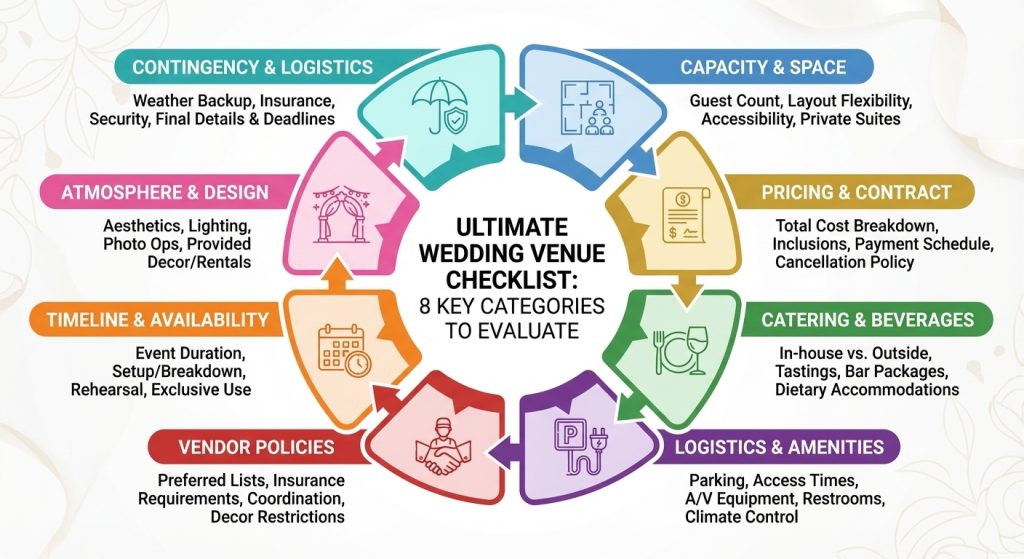
This guide is organized into eight critical categories: capacity and space, pricing and contracts, catering and beverages, logistics and amenities, vendor policies, timeline and availability, design and atmosphere, and contingency planning. By the end, you’ll have a complete framework for evaluating every venue you tour.
Let’s ensure you don’t miss a single important detail.
Capacity & Space Requirements
Guest Count Considerations
□ Maximum capacity (standing vs. seated)
Venues often list different capacities for cocktail-style events versus seated dinners. Confirm the seated dinner capacity since that’s typically your actual need.
□ Minimum guest requirement
Some venues require minimum guest counts (often 100-150+). If your celebration is smaller, you may pay for unused capacity or need to find a different venue.
□ Comfortable space per guest
Calculate whether the space provides adequate room. Industry standard is 12-15 square feet per guest for reception areas. Cramped venues make guests uncomfortable and limit dancing space.
□ Ceremony capacity if hosting on-site
If you’re having your ceremony at the venue, confirm that the ceremony space capacity matches (or exceeds) your reception count. Some venues have smaller ceremony areas.
Layout & Configuration
□ Flexible floor plan options
Can the venue accommodate different layouts (round tables vs. long tables, dance floor size options, stage placement)?
□ Separate areas for different activities
Ideally, venues offer distinct spaces for cocktail hour, dinner, and dancing—or enough flexibility to create these zones within one space.
□ Private spaces for wedding party
Bridal suite and groom’s room provide essential privacy for getting ready, storing belongings, and taking breaks throughout the evening.
□ Accessibility for guests with disabilities
Confirm wheelchair accessibility, restroom accommodations, accessible parking, and whether the venue complies with ADA requirements.
□ Indoor backup space for outdoor venues
If you’re considering outdoor wedding venues, ensure adequate indoor backup exists for weather contingencies.
Pricing & Contract Details
Cost Breakdown
□ Total venue rental fee
Some venues charge flat site fees while others have per-person minimums. Understand the exact pricing structure.
□ What’s included in base price
Clarify whether tables, chairs, linens, setup, breakdown, and coordination are included or cost extra.
□ Food and beverage minimums
Many venues require minimum spending on catering/bar rather than (or in addition to) rental fees.
□ Service charges and gratuity
These typically add 18-25% to your food and beverage total. Factor this into your budget.
□ Tax rates
Sales tax on venue services varies by location. In California, expect 9-10% added to your total.
□ Additional fees
Ask specifically about: cake cutting fees, corkage fees, vendor meal charges, overtime rates, parking fees, cleaning deposits, booking fees.
Payment & Cancellation
□ Deposit amount and due date
Initial deposits typically range from $1,000-$10,000 or 25-50% of estimated total.
□ Payment schedule
When are subsequent payments due? Final payments are typically due 30-60 days before your wedding.
□ Accepted payment methods
Some venues require checks or wire transfers rather than credit cards, which may affect your payment strategy.
□ Cancellation policy
What happens if you need to cancel? Is your deposit refundable under any circumstances? What about postponement policies?
□ Force majeure clause
Recent years have shown the importance of understanding what happens during emergencies, pandemics, natural disasters, or circumstances beyond your control.
□ Contract clarity
Does the contract specify exact spaces you’re renting, timing, included services, and vendor policies? Verbal promises mean nothing—everything must be in writing.
For comprehensive guidance on venue selection, read our detailed guide on how to choose the perfect wedding venue.
Catering & Beverage Service

Food Service
□ In-house catering vs. outside catering
Does the venue require the use of their catering, or can you bring in your own caterer? Each has advantages.
□ Approved caterer list
If outside catering is allowed, is there a preferred vendor list? Can you use any licensed caterer?
□ Menu flexibility and customization
Can you create custom menus, or are you limited to preset packages? Important for dietary restrictions and cultural preferences.
□ Tasting availability
Most venues offer complimentary tastings for 2-4 people. Confirm what’s included and when tastings can be scheduled.
□ Service style options
Plated dinner, buffet, family-style, or stations? Each impacts timing, staffing, and guest experience differently.
□ Dietary accommodation experience
How does the venue handle vegetarian, vegan, gluten-free, kosher, halal, and allergy requirements? Experience matters here.
□ Staff-to-guest ratio
Quality service requires adequate staffing. For plated service, look for 1 server per 20-25 guests. For buffets, 1 per 40-50 guests.
□ Kitchen facilities
If bringing outside catering, confirm kitchen access, equipment available, and any restrictions. Learn more in our wedding caterer selection guide.
Bar Service
□ Bar package options
Venues typically offer tiered packages: house brands, premium, top-shelf. Compare what’s included in each.
□ Beer and wine only vs. full bar
Limiting to beer/wine significantly reduces costs while still providing alcohol service.
□ Open bar vs. cash bar vs. consumption bar
Open bars are most common but most expensive. Consumption bars charge only for drinks served. Cash bars are generally frowned upon for weddings.
□ Champagne toast inclusion
Is champagne for toasts included, or does that cost extra per person?
□ Bar service duration
Does the bar close 30 minutes before the end of your event? Some venues close bars early to encourage guest departure.
□ Bartender requirements
How many bartenders will be provided? For 100 guests, expect 1-2 bartenders minimum.
□ Corkage fees
If you’re bringing your own wine or champagne, what’s the per-bottle corkage fee? Typically $15-35 per bottle.
Logistics & Amenities
Practical Considerations
□ Parking capacity and cost
How many parking spaces are available? Is parking free, validated, or paid? Is valet service available or required?
□ Load-in and setup access
When can vendors begin setup? Is there easy load-in access or will florists need to carry arrangements up stairs?
□ Venue access timeline
How many hours before your event can you access the space? When must everything be cleared out?
□ Power and electrical capacity
Sufficient power for DJs, bands, lighting, and photo booths? Are there additional charges for power usage?
□ WiFi availability
Increasingly important for photo sharing, live streaming, and vendor coordination.
□ Climate control
Is the space adequately heated/air-conditioned? Who controls temperature settings?
□ Restroom facilities
Sufficient restrooms for your guest count? (Minimum 1 toilet per 75 guests). Are restrooms ADA accessible and well-maintained?
□ Coat check availability
For winter weddings, coat storage is essential. Does the venue provide coat check service?
Audio/Visual Equipment
□ Sound system quality and coverage
Does the venue provide a sound system? Is it adequate for your space size and guest count?
□ Microphones for ceremony
Wireless microphones for officiant, readings, and vows? Even outdoor ceremonies need amplification.
□ Projector and screen availability
If you’re planning slideshows or videos, confirm AV equipment availability and any associated fees.
□ Lighting capabilities
What’s the existing lighting? Can it be dimmed? Are uplighting, pin spotting, or additional lighting options available?
□ Technical support
Is there on-site technical staff to handle AV equipment, or are you responsible for managing technology?
For entertainment planning, explore our guide to choosing the perfect wedding DJ.
Vendor Policies & Coordination
Vendor Requirements
□ Preferred vendor list
Is there a list of recommended vendors? Are you required to choose from this list?
□ Restrictions on outside vendors
Can you bring any licensed and insured vendor, or are certain categories restricted (commonly: catering, bar service)?
□ Vendor meal requirements
Are you required to provide meals for vendors (photographers, DJs, coordinators)? At what cost per meal?
□ Vendor insurance requirements
What insurance coverage must vendors carry? Typically $1-2 million liability coverage.
□ Coordination services included
Does the venue provide day-of coordination? If so, what exactly does that include?
□ Setup and breakdown responsibility
Who handles setup and breakdown? If vendors are responsible, when does this occur?
□ Decoration restrictions
Any restrictions on decorations? Common limitations: no nails/tacks in walls, no open flames, no confetti/glitter.
Music & Entertainment
□ Noise restrictions and curfews
What time must music end? Are there decibel limits? This particularly matters for outdoor venues in residential areas.
□ Live band vs. DJ capabilities
Does the space accommodate live bands with adequate staging, power, and acoustic considerations?
□ Dance floor requirements
Is a dance floor included, or do you need to rent one? What sizes are available?
□ Entertainment load-in logistics
Can bands/DJs load equipment through main entrances, or is there a service entrance?
Timeline & Availability
Scheduling Considerations
□ Available dates
Confirm your preferred dates are available. Peak season Saturdays book 12-18 months in advance.
□ Event duration included
How many hours are included in your package? Standard is 5-6 hours, but what if you want more?
□ Ceremony time if on-site
If hosting your ceremony at the venue, what are the time options? Does ceremony time count toward your rental hours?
□ Setup and breakdown time
Are setup and breakdown hours included in your rental time, or are they additional?
□ Rehearsal availability
Can you do a walk-through or rehearsal the day before? Is there a fee?
□ Other events on same day
Will other weddings or events be happening simultaneously? How does the venue manage multiple events?
□ Exclusive use vs. shared space
Do you have exclusive access to the entire venue, or are certain areas shared with other events/guests?
Booking Timeline
□ How far in advance to book
When should you realistically book to secure your date? According to The Knot’s research, most couples book venues 12-14 months before their wedding.
□ Hold/option period
Can the venue hold your date temporarily while you make decisions? How long?
□ What secures the date
Is a signed contract and deposit required, or does a verbal commitment hold dates?
Atmosphere & Design Elements
Aesthetic Considerations
□ Natural lighting
How does the space look at different times of day? Tour at the same time as your planned event.
□ Built-in decor and design
What architectural features and design elements already exist? Beautiful venues require less additional decor.
□ Color palette and finishes
Do existing colors and finishes complement your wedding colors, or will they clash?
□ Ceiling height
High ceilings create dramatic ambiance, while low ceilings feel more intimate. Neither is inherently better: it depends on your vision.
□ Photo opportunity locations
Are there beautiful backdrop options for photos? Indoor and outdoor options?
□ Seasonal considerations
How does the venue look/feel in your wedding season? Gardens beautiful in June may be sparse in January.
Provided Elements
□ Tables and seating
What style of tables and chairs are included? Round tables, rectangular, both? Chair styles?
□ Linens and place settings
Are tablecloths, napkins, china, glassware, and flatware included? Quality and style?
□ Centerpiece requirements
Does the venue provide centerpieces, or are you responsible? Are there height restrictions?
□ Existing floral or greenery
Some venues have beautiful existing plants or permanent floral installations that reduce your florist needs.
Contingency Planning & Logistics
Weather Backup (If Applicable)
□ Rain plan for outdoor elements
What’s the specific backup plan if weather is poor? Indoor space? Tent options?
□ Who makes weather call and when
When must you decide between outdoor and indoor? 24 hours? 72 hours? Who decides?
□ Tent availability and cost
If tents are the backup, are they included or additional cost? What’s the expense?
□ Heating/cooling for tents
Can tents be climate-controlled? What’s the additional cost?
Risk Management
□ Insurance requirements
Does the venue require you to carry event liability insurance? Typical coverage is $1-2 million. Wedding insurance costs $150-350.
□ Security requirements
Are you required to hire security? For what size guest count?
□ Alcohol service policies
What are the venue’s policies regarding intoxicated guests? Liability concerns?
□ Emergency procedures
What are emergency exits, procedures, and venue staff training for emergencies?
Final Details
□ Final guest count deadline
When is the final headcount due? Typically 7-14 days before your wedding. After this, you pay for the guaranteed count even if fewer guests attend.
□ Site visit timing
When can you do a final walkthrough to confirm setup, decorations, and layout?
□ Day-of contact person
Who is your point person on the wedding day? Venue manager? Catering manager? Coordinator? Get direct contact information.
□ Post-event logistics
What happens to gifts, decorations, and personal items after the event? When must they be collected?
Questions to Ask During Your Venue Tour
Beyond this checklist, here are essential questions to ask during tours:
About Experience:
- How many weddings do you host annually?
- Can you provide references from recent couples?
- Have you hosted weddings similar to ours (cultural traditions, size, style)?
About Logistics:
- What happens if we run over our contracted time?
- Can we bring in our own DJ/band/photographer?
- Are there any additional fees we haven’t discussed?
About Food:
- Can we do a tasting that includes our actual menu selections?
- How do you handle last-minute guest count changes?
- What’s your experience with our specific dietary needs?
Deal-Breakers:
- What’s your cancellation rate? (High cancellation rates suggest problems)
- Can we see the space set up for an actual event? (Not just empty rooms)
- What’s included in “day-of coordination”? (This varies tremendously)
How to Use This Wedding Venue Checklist Effectively
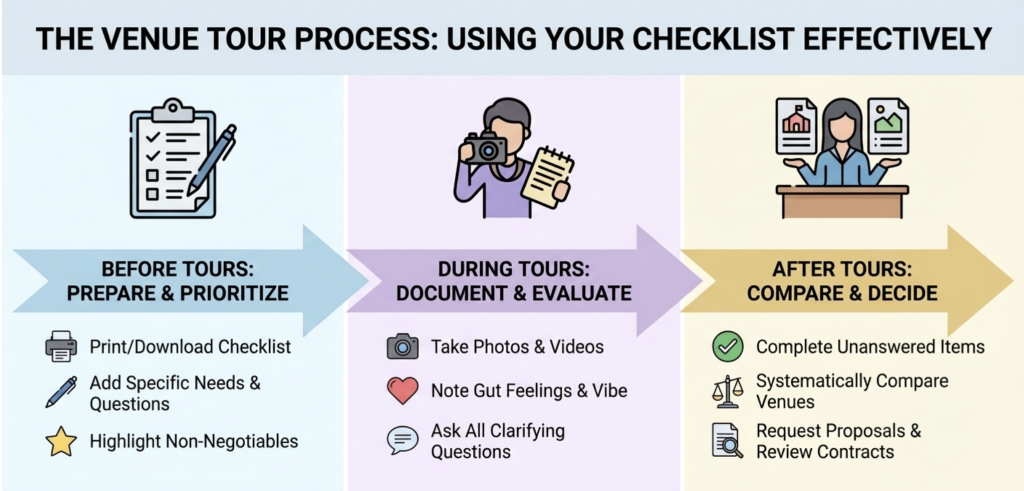
Before Tours
1. Print or download this checklist
Bring copies to every venue tour so you can take notes directly on the page.
2. Add your specific requirements
Every couple has unique needs. Add questions about your specific cultural traditions, accessibility requirements, or special requests.
3. Prioritize your must-haves
Highlight non-negotiable items so you can quickly eliminate venues that don’t meet essential requirements.
During Tours
1. Take photos and videos
Venues blur together after touring multiple spaces. Visual documentation helps you remember each venue’s unique features.
2. Note your emotional response
How does the space make you feel? You’ll spend countless hours planning and your wedding day here: your gut reaction matters.
3. Ask about everything unclear
No question is too small. Clarity now prevents surprises later.
After Tours
1. Complete any unanswered items
Follow up via email on questions you didn’t ask or couldn’t get answered during tours.
2. Compare venues systematically
Use your completed checklists to create comparison charts. What’s included at each venue? Total costs? Pros and cons?
3. Request proposals in writing
Get detailed proposals with itemized pricing for final decision-making.
4. Review contracts carefully
Have someone else (parent, friend, coordinator) review contracts before signing. Fresh eyes catch details you might miss.
Red Flags to Watch For
🚩 Pressure to book immediately: Quality venues are confident. Pressure tactics suggest desperation.
🚩 Unwillingness to show contracts: Legitimate venues share contracts during initial consultations.
🚩 Vague pricing: “Around $X per person” isn’t sufficient. You need itemized, detailed quotes.
🚩 Poor communication: If they’re unresponsive now, imagine the stress during planning.
🚩 Negative online reviews mentioning the same issues: One bad review happens. Ten reviews mentioning terrible food or unprofessional service? Believe them.
🚩 Hidden fees: Surprise charges for “cake cutting” or “setup” suggest poor transparency.
🚩 No references available: Established venues readily provide recent couple contacts.
Find Your Perfect Venue with Confidence With Zaal
Armed with this comprehensive wedding venue checklist, you’re prepared to tour venues systematically, ask the right questions, and make informed decisions.
Whether you’re exploring Glendale wedding venues, Armenian banquet halls, or outdoor garden estates, this checklist ensures you don’t overlook critical details.
Streamline Your Venue Search with Zaal
While this checklist helps you evaluate venues thoroughly, the process of finding, comparing, and booking venues has traditionally been time-consuming and fragmented—until now.
Zaal transforms the venue search experience by creating the first digital marketplace specifically for Los Angeles event venues. Instead of calling dozens of venues, tracking information across spreadsheets, and coordinating multiple tours, Zaal centralizes everything you need.
Here’s how Zaal makes venue selection easier:
✅ Browse 40+ vetted venues in one place: From luxury ballrooms to intimate garden spaces, compare venues side-by-side with detailed photos, capacity information, and transparent pricing.
✅ Check real-time availability: See which venues have your preferred dates available without calling around or waiting for email responses.
✅ Book tours directly: Schedule venue tours through the platform, managing all your appointments in one organized system.
✅ Access transparent pricing: See upfront costs and compare packages across venues, eliminating surprise fees and helping you make budget-conscious decisions.
✅ Get expert guidance: Access planning resources, venue comparison tools, and support from teams who understand the LA wedding landscape.
✅ Save time and reduce stress: What used to take weeks of phone calls and coordination now happens in hours through one streamlined platform.
Whether you’re planning a traditional celebration at an Armenian banquet hall, a modern affair at a luxury venue like Taglyan Grand Ballroom, or an elegant gathering at any of dozens of exceptional spaces, Zaal connects you with venues that match your vision and budget.
The platform was built by people who’ve experienced the venue search frustration firsthand and wanted to create a better solution. Zaal eliminates the overwhelming chaos of venue hunting and replaces it with organized, efficient decision-making.
Start exploring venues on Zaal today to see how much easier wedding planning becomes when you have the right tools and comprehensive information at your fingertips.
Your perfect venue is out there. Zaal helps you find it with confidence, clarity, and considerably less stress.