


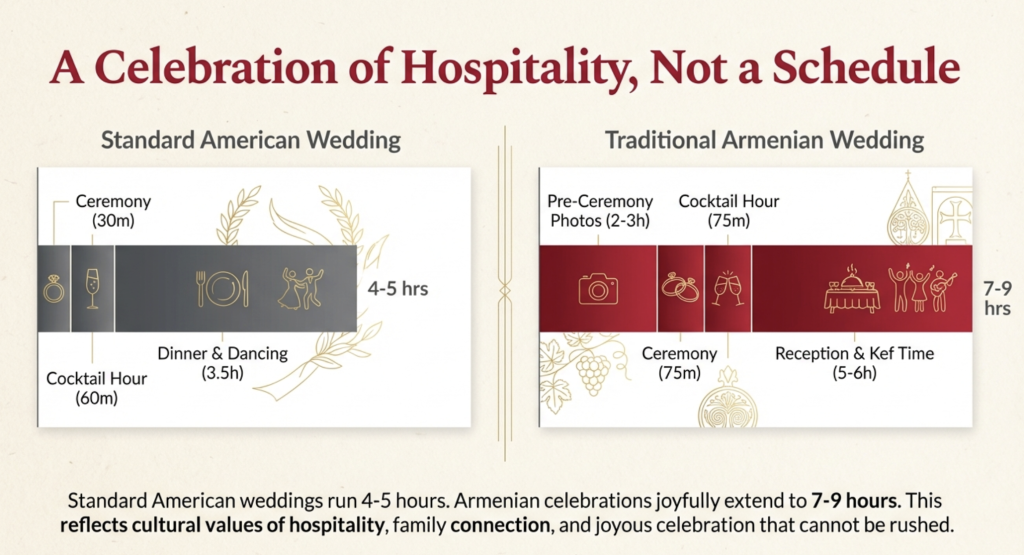
The Armenian wedding timeline differs significantly from typical American wedding schedules. Where standard Los Angeles weddings run 4-5 hours from ceremony through reception end, Armenian celebrations naturally extend 7-9 hours from the first pre-ceremony photos through the final dance. This extended Armenian wedding reception schedule reflects cultural values of hospitality, family connection, and joyous celebration that cannot be rushed.
Planning your timeline requires understanding which cultural elements take longer than American equivalents, where flexibility benefits celebration flow versus where structure maintains smooth coordination, how to pace energy across extended hours so guests remain engaged throughout, and when traditional Armenian moments occur within the broader reception structure.
This comprehensive guide provides a detailed Armenian wedding timeline from getting ready through grand exit, explaining each phase’s purpose and cultural significance, offering minute-by-minute scheduling recommendations, identifying coordination points with vendors and venue, and highlighting where you can adjust based on your specific preferences while maintaining cultural authenticity.
Whether you are planning a deeply traditional Armenian celebration or blending cultural elements with modern preferences, this timeline ensures your day flows smoothly while honoring the heritage that makes Armenian weddings so meaningful.
Let us walk through your perfect Armenian wedding day schedule.
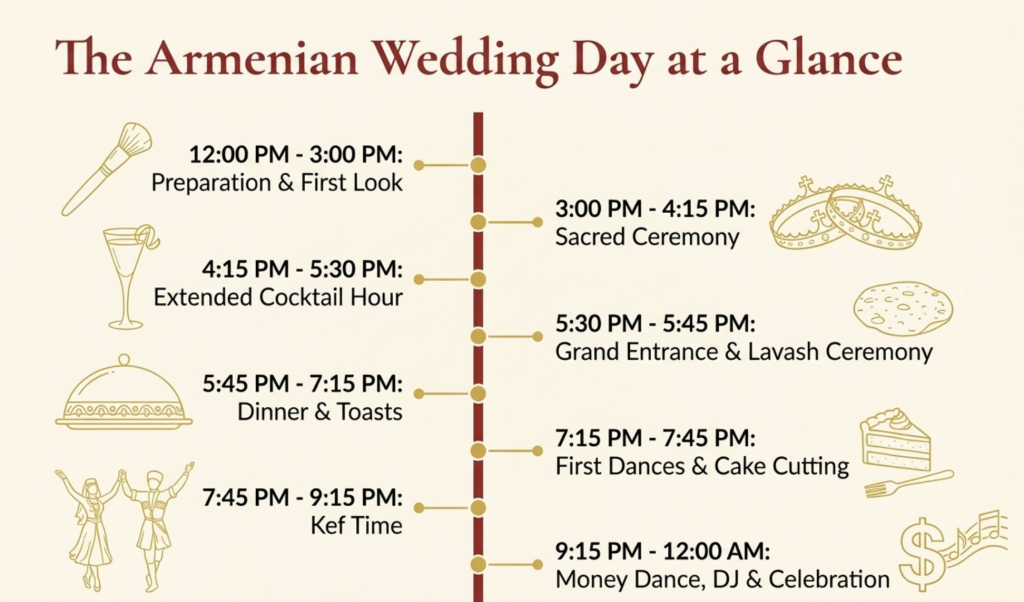
Pre-Ceremony: Getting Ready Phase (2-3 Hours Before Ceremony)
Bride’s Preparation: 12:00 PM – 3:00 PM (For 3:00 PM Ceremony)
12:00 PM – 1:30 PM: Hair and Makeup
The bride, bridesmaids, and mothers get professional hair and makeup services. This intimate time with female family creates bonding moments before the celebration intensity begins.
Cultural element: Some families incorporate the veil placement tradition here, where the groom’s mother or respected married woman from his family places the veil on the bride, symbolizing her transition into the groom’s family. This tender moment often becomes deeply emotional.
Timeline tip: Schedule makeup artists to finish the bride last so her look stays fresh longest. Start bridesmaids and mothers first.
1:30 PM – 2:30 PM: Dress and Final Preparations
The bride gets into her dress with help from female family members. This is when something old, something new, something borrowed, something blue gets incorporated, along with any Armenian cultural items like a small blue ribbon to ward off the evil eye.
2:30 PM – 3:00 PM: First Look and Pre-Ceremony Photos
If doing a first look with the groom, schedule this private moment allowing genuine emotion without ceremony audience. Even without a first look, use this time for bridal party photos, family portraits, and detail shots of dress, jewelry, and flowers.
Groom’s Preparation: 1:00 PM – 3:00 PM
1:00 PM – 2:00 PM: Getting Dressed
The groom and groomsmen get ready together, creating relaxed bonding time. This is when boutonnieres get pinned and final suit adjustments happen.
2:00 PM – 3:00 PM: Pre-Ceremony Photos
Groom portraits with groomsmen, family photos with parents and siblings, and if doing a first look, the emotional moment of seeing the bride for the first time.
Understanding Armenian wedding traditions helps you decide which pre-ceremony customs to incorporate.
Armenian Orthodox Ceremony: 3:00 PM – 4:15 PM (75 Minutes)
Ceremony Structure and Timeline
3:00 PM – 3:10 PM: Guest Seating and Prelude Music
Guests arrive and are seated. Prelude music (often traditional Armenian church music or classical pieces) creates reverent atmosphere.
3:10 PM – 3:15 PM: Processional
The wedding party processes down the aisle in traditional order: groomsmen, bridesmaids, flower girl and ring bearer, maid of honor, best man, groom (often with his parents), and finally the bride with her father.
3:15 PM – 4:00 PM: Armenian Orthodox Ceremony
Traditional Armenian Orthodox ceremonies last 45-60 minutes, significantly longer than typical 20-30 minute Western ceremonies. Key elements include:
The Betrothal: The couple is officially betrothed with rings blessed and exchanged.
The Crowning (Psakadrut’yun): The priest places crowns on the couple’s heads, symbolizing them becoming king and queen of their household. This powerful moment represents their new authority and responsibility.
The Common Cup: The bride and groom drink from the same cup of wine, symbolizing the shared joys and sorrows they will face together throughout their marriage.
Walking Around the Altar: The couple circles the altar three times, representing their eternal journey together and the Holy Trinity blessing their union.
Biblical Readings and Blessings: Specific passages emphasizing marriage as sacred covenant, family building, and divine blessing.
The Joining of Hands: The priest binds the couple’s hands together with his vestment, physically demonstrating their union before God and community.
4:00 PM – 4:15 PM: Recessional and Post-Ceremony Photos
The newly married couple recesses back down the aisle as husband and wife. Immediately after, family and wedding party photos occur while guests transition to cocktail hour.
Timeline consideration: Armenian Orthodox ceremonies cannot be shortened. Build the full 75 minutes into your schedule. If having a non-religious ceremony, you can condense to 30-45 minutes.
Cocktail Hour: 4:15 PM – 5:30 PM (75 Minutes)
Extended Cocktail Hour for Armenian Weddings
Why 75 minutes instead of standard 60 minutes:
Armenian weddings benefit from extended cocktail hours allowing more generous photo time for the couple while guests enjoy themselves, adequate mingling for large guest counts (250-400 people need more time to greet each other), and smooth room flip if ceremony and reception occur in the same space.
4:15 PM – 5:00 PM: Guest Cocktail Hour
Passed appetizers: Waitstaff circulate with 6-8 different appetizer varieties. For Armenian celebrations, include traditional options:
- Dolma (stuffed grape leaves)
- Armenian cheese and lavash
- Hummus and vegetable platters
- Grilled meat skewers
- Stuffed mushrooms
- Spanakopita
- Fresh fruit displays
Bar service: Open bar with signature cocktails, wine, beer, and Armenian brandy/cognac for those who appreciate traditional spirits.
Music: Background music (jazz, classical, or light contemporary) creates pleasant atmosphere without overwhelming conversation.
5:00 PM – 5:30 PM: Final Photos and Prep for Grand Entrance
The couple finishes remaining formal portraits and family photos. The bridal party touches up makeup and prepares for the grand entrance. The DJ or band does final sound checks.
Selecting experienced Armenian wedding vendors who understand cultural timing ensures smooth transitions.
Grand Entrance and Lavash Ceremony: 5:30 PM – 5:45 PM
5:30 PM: Grand Entrance
Announcement order:
- Parents of the groom
- Parents of the bride
- Wedding party (bridesmaids and groomsmen together)
- Maid of honor and best man
- Flower girl and ring bearer
- The newly married couple
Music: Upbeat, celebratory music announces each group. Armenian couples often choose a mix of popular celebration songs that get guests excited and on their feet immediately.
5:35 PM: Lavash Ceremony
The most iconic Armenian wedding tradition: As the newlyweds enter the reception, the groom’s mother greets them at the entrance holding a piece of traditional lavash (thin flatbread) on a tray. She places the lavash on the groom’s shoulder first, then the bride’s shoulder. The couple breaks the lavash with their shoulders to see whose piece is larger.
Symbolism:
- The lavash represents prosperity and sustenance, blessing the couple with abundance
- Breaking the bread symbolizes the couple breaking through life’s obstacles together
- Some believe whoever gets the larger piece will be the household “boss,” adding playful competition
- The tradition represents the couple’s entry into their new life together
Timeline: This tradition takes about 5 minutes but creates one of the most memorable and photographed moments of the entire celebration.
5:40 PM – 5:45 PM: Couple Proceeds to Head Table
After the lavash ceremony, the couple walks to their head table or sweetheart table while guests cheer and applaud. This is when the celebration truly begins.
Dinner Service: 5:45 PM – 7:15 PM (90 Minutes)
Extended Dinner for Family-Style Service
Armenian wedding dinner service takes longer than American equivalents because:
Family-style service requires coordinated delivery of multiple platters to each table simultaneously, abundant food presentation means more courses and larger quantities, traditional Armenian hospitality emphasizes generous portions requiring multiple rounds, and cultural expectations for leisurely dining rather than rushed service.
5:45 PM – 6:00 PM: Welcome Toast and Blessing
First toast (typically from father of the groom): Welcomes all guests, blesses the couple, shares wisdom about marriage, and raises glass in their honor. Toasts in Armenian weddings are meaningful and often longer than American equivalents (3-5 minutes each).
Blessing before meal: Some families have a priest or elder offer a blessing over the meal before service begins.
6:00 PM – 7:00 PM: Main Dinner Service
Family-style service flow:
First course (6:00 PM – 6:20 PM): Salads and appetizers arrive on large platters for each table. Guests pass and share, creating communal dining experience.
Main courses (6:20 PM – 7:00 PM): Hot entrees arrive including:
- Khorovats (Armenian BBQ: lamb, chicken, beef kebabs)
- Pilaf with vermicelli
- Roasted vegetables
- Additional sides and sauces
Beverage service throughout: Wine, cocktails, water, and soft drinks refilled continuously.
Understanding Armenian wedding catering ensures your food service meets cultural expectations.
7:00 PM – 7:15 PM: Additional Toasts During Dinner
Multiple family members offer toasts throughout dinner:
- Father of the bride
- Best man and maid of honor
- Godparents (kavor and kavorkin)
- Other family members as desired
Armenian toasting customs:
- Toasts occur throughout the evening, not just during dinner
- Traditional phrases include “Genats!” (cheers) and “Shnorhavor!” (congratulations)
- Armenian cognac or wine is preferred for toasts
- Everyone drinks together after each toast
Timeline flexibility: The number and length of toasts impact overall dinner timing. Build flexibility into this portion of your schedule.
First Dances and Special Moments: 7:15 PM – 7:45 PM
7:15 PM – 7:20 PM: First Dance
The newly married couple’s first dance as husband and wife. Armenian couples choose songs ranging from traditional Armenian love songs to contemporary American hits, depending on personal preference and family expectations.
Timeline note: First dances often occur before cake cutting in Armenian weddings, unlike American weddings where cake cutting sometimes comes first.
7:20 PM – 7:30 PM: Parent Dances
Father-daughter dance: The bride dances with her father to a meaningful song, often an emotional highlight of the evening.
Mother-son dance: The groom dances with his mother, honoring their relationship.
Cultural note: Some Armenian families incorporate additional family dances here, such as the bride dancing with her father-in-law or the groom dancing with his mother-in-law, symbolizing new family bonds.
7:30 PM – 7:45 PM: Cake Cutting
The couple cuts their wedding cake together while guests gather around for photos. The couple feeds each other the first bite (gently or playfully, depending on their style).
Dessert service: Following the cake cutting, venue staff serves cake slices and traditional Armenian desserts (baklava, gata) to tables, or guests approach a dessert buffet.
Kef Time: The Heart of Armenian Celebrations: 7:45 PM – 9:15 PM (90 Minutes)
The Cultural Centerpiece of Armenian Wedding Receptions
Kef time is the portion of the reception dedicated entirely to traditional Armenian music and dancing. The word “kef” roughly translates to “pleasure” or “good times.” This is when generations unite on the dance floor in participatory joy that defines Armenian celebrations.
7:45 PM – 9:15 PM: Traditional Armenian Music and Dancing
What happens during kef time:
Live Armenian band takes over: The DJ steps aside as the live Armenian band begins playing traditional songs everyone knows and loves. The energy shift is immediate and electric.
Traditional dances:
Tamzara: The signature Armenian group dance. Dancers hold hands in a line or circle, performing synchronized steps. New dancers easily join by grabbing the line, creating an ever-growing celebration.
Yarkhushta: A men’s dance showcasing strength and skill. Men form competing lines, performing aggressive, martial-style movements in friendly competition.
Kochari: Another traditional circle dance with variations across Armenian regions. The leader improvises while others follow, creating spontaneous joy.
Shalakho: A solo dance where individuals (traditionally men) showcase skill through fast footwork and dramatic movements, often during emotionally charged moments.
Why kef time is special: This is not performance; it is participatory joy. Your 90-year-old grandmother dances next to your five-year-old niece. Everyone knows the steps, passed down through generations. The energy is electric, the connection palpable.
Duration considerations: Kef time can last 60-120 minutes depending on crowd energy and band stamina. The 90-minute allocation works for most celebrations, but remain flexible. If energy is incredible, extend it. If the crowd tires earlier, transition sooner.
Timeline flexibility: This is the most flexible portion of your Armenian wedding reception schedule. Let the moment dictate duration rather than watching the clock rigidly.
Explore Armenian wedding traditions for deeper understanding of kef time’s cultural significance.
Money Dance and Additional Celebrations: 9:15 PM – 9:45 PM
9:15 PM – 9:30 PM: Money Dance
Armenian weddings feature enthusiastic money dances where guests pin cash to the bride and groom’s clothing while dancing with them briefly. This tradition serves multiple purposes: providing financial blessing to help the couple start married life, allowing every guest a personal moment to celebrate with the couple and offer well-wishes, and creating memorable (if somewhat chaotic) photo opportunities.
How it works: Guests line up to dance briefly with the bride or groom, pinning money to their clothing during the dance. Some families designate helpers to collect money as it’s pinned for safety.
Timeline consideration: With 250-400 guests, money dances can extend 20-30 minutes. Some couples prefer collecting monetary gifts in cards rather than the pinning tradition, which shortens this portion significantly.
9:30 PM – 9:45 PM: Bouquet and Garter Toss (Optional)
Bouquet toss: The bride tosses her bouquet to single female guests. Tradition says whoever catches it will marry next.
Garter toss: The groom removes the bride’s garter and tosses it to single male guests.
Cultural note: These American traditions are optional for Armenian weddings. Many couples skip them entirely or do modified versions. Include only if meaningful to you.
Contemporary Dancing and Late-Night Celebration: 9:45 PM – 12:00 AM
9:45 PM – 11:30 PM: DJ Takes Over for Contemporary Music
After kef time’s intensity, the DJ returns with contemporary music spanning multiple generations:
9:45 PM – 10:30 PM: High-energy contemporary hits (current pop, hip-hop, dance music) that younger guests love
10:30 PM – 11:00 PM: Mix of eras (80s, 90s, 2000s throwbacks) appealing to various age groups
11:00 PM – 11:30 PM: Continued celebration with requests and crowd favorites
Energy management: Professional DJs read the room, adjusting tempo and genre based on who’s dancing and overall energy levels. Trust your DJ’s experience managing this phase.
11:30 PM – 11:45 PM: Last Dance and Final Moments
Last dance announcement: The DJ or band announces the last song, bringing everyone back to the dance floor for a final celebration together.
Song choice: Choose a meaningful song that represents your relationship or simply one that brings everyone together for a joyful final moment.
Timeline note: Armenian celebrations naturally resist ending. Even after the “last dance,” celebration often continues another 15-30 minutes with spontaneous dancing and reluctant farewells.
11:45 PM – 12:00 AM: Grand Exit (Optional)
If planning a grand exit: Sparkler send-off, confetti toss, vintage car departure, or another creative exit creates a photogenic final moment.
Reality check: Many Armenian couples skip formal exits, instead gradually saying goodbye to guests who linger, visiting with family, and savoring final moments rather than rushing away.
Understanding Armenian wedding planning helps you decide which elements matter most to your family.
Timeline Adjustments for Different Scenarios
Morning or Afternoon Ceremonies
For 11:00 AM ceremony:
- 8:00 AM: Getting ready begins
- 11:00 AM – 12:15 PM: Ceremony
- 12:15 PM – 1:30 PM: Cocktail hour
- 1:30 PM – 8:00 PM: Reception phases
- 8:00 PM: Celebration ends (still 6.5 hours)
Advantage: Earlier end time works well for families with young children and elderly guests who tire by late evening.
Challenge: Morning preparations are more rushed; some guests may skip brunch to attend.
Evening Ceremonies
For 6:00 PM ceremony:
- 3:00 PM: Getting ready begins
- 6:00 PM – 7:15 PM: Ceremony
- 7:15 PM – 8:30 PM: Cocktail hour
- 8:30 PM – 2:00 AM: Reception phases
- 2:00 AM: Celebration ends
Advantage: More relaxed daytime preparations; guests have full day to get ready.
Challenge: Very late end time; celebrations extending past midnight may incur overtime charges at some venues.
Blended Cultural Ceremonies
If incorporating both Armenian Orthodox and another tradition (Catholic, Protestant, civil):
Add 30-45 minutes to ceremony time for the second tradition. Consider whether both occur consecutively or with a break between. Plan cocktail hour extension if needed for longer ceremony and photo time.
Coordination with Venue and Vendors
Timeline Distribution
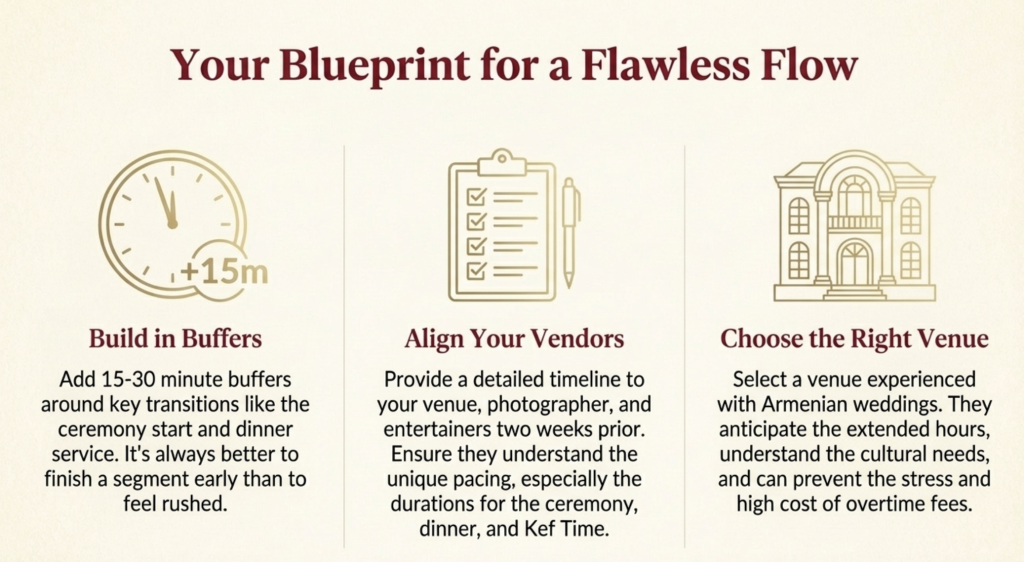
Provide detailed timelines to:
- Venue coordinator (2 weeks before)
- Photographer and videographer (2 weeks before)
- DJ and band (2 weeks before)
- Hair and makeup artists (1 week before)
- Transportation coordinator (1 week before)
- Wedding planner if you have one (ongoing)
Venue-Specific Considerations
Different venues in Glendale and throughout Los Angeles have varying time policies:
Confirm with your venue:
- Base package hours included
- When that time officially starts and ends
- Overtime rates if celebration runs long
- Load-in time for vendors
- Load-out deadline after celebration ends
Venues like Imperial Palace, Kalaydjian, and Royal Palace have extensive Armenian wedding experience and understand naturally extended timelines.
Buffer Time Strategy
Build 15-30 minute buffers around:
- Ceremony start (in case bride runs late or guests arrive slowly)
- Cocktail hour (if photos run long)
- Dinner service (family-style takes time)
- Transitions between reception phases
Better to finish early than run late: Early finishes feel celebratory. Running late creates stress, potential overtime charges, and rushed final moments.
Your Armenian Wedding Timeline Planned Perfectly
The Armenian wedding timeline reflects cultural values that prioritize family connection, generous hospitality, and joyous celebration over rigid efficiency. Your 7-9 hour celebration from ceremony through final dance creates space for meaningful moments: the sacred ceremony traditions, the iconic lavash ceremony welcome, the abundant family-style dinner with multiple toasts, the electric energy of kef time uniting generations, and the contemporary celebration bringing everyone together one final time.
Planning this extended timeline requires coordination with culturally experienced venues and vendors, realistic scheduling that accounts for cultural elements taking longer than American equivalents, and flexibility to let certain moments (especially kef time) unfold naturally rather than being rigidly controlled.
Choose Venues That Support Extended Armenian Celebrations
Your venue choice dramatically impacts how smoothly your timeline flows. Venues experienced with Armenian weddings anticipate timing needs, accommodate extended hours without punitive overtime charges, coordinate seamlessly with Armenian musicians and vendors, and facilitate rather than restrict cultural traditions.
Zaal connects you with venues throughout Los Angeles, particularly in Glendale, that understand and embrace the naturally extended Armenian wedding reception schedule.
Here is how Zaal helps you plan the perfect timeline:
✅ Identify timeline-friendly venues: See which venues accommodate 6-8+ hour celebrations comfortably without excessive overtime penalties.
✅ Armenian expertise confirmation: Connect with venues that have coordinated hundreds of Armenian weddings and understand cultural timing instinctively.
✅ Extended hours clarity: Understand exactly what is included in base packages versus what costs extra, making realistic budget planning possible.
✅ Coordination capabilities: Find venues with experienced staff who seamlessly manage transitions between ceremony, cocktail hour, dinner, kef time, and contemporary dancing.
✅ Flexible celebration support: Identify venues that embrace the natural flow of Armenian celebrations rather than rigidly enforcing American timing standards.
Review our venue selection guide and venue checklist alongside timeline considerations to choose venues that support your celebration vision.
Featured venues including Imperial Palace Banquet Hall, Kalaydjian Banquet Hall, Royal Palace Banquet Hall, and Sayat Nova Banquet Hall all have decades of experience managing extended Armenian wedding timelines smoothly.
Explore timeline-friendly Armenian wedding venues on Zaal today to find spaces where your celebration can unfold naturally without time constraints that compromise cultural authenticity.
Your Armenian wedding timeline deserves venues that honor its natural rhythm. Zaal helps you find them.
Frequently Asked Questions
How long does a typical Armenian wedding last?
Armenian weddings typically last 7-9 hours from ceremony through reception end, significantly longer than standard American weddings (5-6 hours total). The ceremony alone takes 75 minutes if Armenian Orthodox (versus 30 minutes for typical American ceremonies), cocktail hour runs 75 minutes (versus 60 minutes), dinner service extends 90 minutes due to family-style service and multiple toasts (versus 60 minutes plated service), and kef time adds 60-120 minutes of traditional Armenian dancing not present in American weddings. Contemporary dancing continues 2-3 hours after kef time. This extended timeline reflects Armenian cultural values of hospitality, family connection, and celebration that cannot be rushed.
What is kef time and how long does it last?
Kef time is the portion of Armenian wedding receptions dedicated entirely to traditional Armenian music and dancing. “Kef” translates roughly to “pleasure” or “good times.” During kef time, a live Armenian band plays traditional songs while guests perform participatory group dances like Tamzara, Kochari, and Yarkhushta. Everyone from toddlers to grandparents joins hands in circle or line dances, creating multigenerational celebration moments unique to Armenian weddings. Kef time typically lasts 60-120 minutes depending on crowd energy and band stamina, with 90 minutes being most common. This is the emotional and energetic peak of Armenian receptions, so let it unfold naturally rather than cutting it short artificially.
When does the lavash ceremony happen in the reception timeline?
The lavash ceremony occurs immediately upon the newlywed couple’s grand entrance into the reception, typically 5-10 minutes after guests have been seated following cocktail hour. As the couple enters, the groom’s mother greets them at the entrance holding traditional lavash (flatbread) on a tray. She places the lavash on their shoulders, and they break it together. This iconic Armenian tradition takes about 5 minutes total but creates one of the most memorable and photographed moments of the entire celebration. Schedule this immediately after the couple is announced but before they proceed to their head table. Ensure your photographer and videographer are positioned to capture this tradition from multiple angles.
How much time should we allocate for dinner at an Armenian wedding?
Allocate 90 minutes for dinner service at Armenian weddings (versus 60 minutes typical for American weddings). Family-style service requires coordinated delivery of multiple platters to each table simultaneously, abundant food presentation means more courses, traditional Armenian hospitality emphasizes generous portions often requiring multiple serving rounds, and multiple toasts throughout dinner extend timing. Dinner at Armenian weddings is also more leisurely, reflecting cultural values of enjoying food and company rather than rushing through courses. If you are having buffet service instead of family-style, you can reduce this slightly to 75 minutes, but still plan longer than American buffet timings due to larger guest counts and traditional toasting customs.
Can we shorten our Armenian wedding timeline to fit standard venue packages?
While you can condense some elements, Armenian weddings naturally require 6-8+ hours to honor cultural traditions properly. If venue packages only include 5-6 hours, you will face trade-offs: skip or significantly shorten kef time (not recommended as it is the cultural centerpiece), rush dinner service (creates stress and disappoints guests), cut cocktail hour short (insufficient time for photos and guest mingling), end contemporary dancing early (guests often feel celebration is cut short), or pay overtime charges (budget for this reality). Better approach: choose venues experienced with Armenian weddings that offer 6-8 hour packages as standard. Glendale venues specializing in Armenian celebrations structure packages around realistic cultural timing rather than forcing Armenian weddings into American timeframes.
What if our celebration naturally runs longer than our contracted time?
Armenian celebrations frequently extend past contracted times because cultural momentum resists artificial endpoints. Strategies to manage this: build 30-60 minute buffer into your contract (book 7 hours if you expect 6-7 hours), understand overtime rates before booking (should be reasonable $500-$1,000 per hour, not punitive), choose venues experienced with Armenian weddings that embrace extended celebrations, communicate with your coordinator and DJ about natural endpoints rather than hard stops, and budget 1-2 hours of potential overtime ($1,000-$2,000) as contingency. Venues like Imperial Palace, Kalaydjian, and Royal Palace understand Armenian celebration rhythms and work with couples flexibly rather than enforcing rigid cutoffs that undermine celebration energy.
Should dinner come before or after kef time?
Dinner should always precede kef time in the Armenian wedding timeline. Guests need substantial food before the energetic dancing of kef time, service staff cannot deliver food effectively during intense dancing, traditional toasts occur during dinner and would disrupt kef time flow, and the energy progression flows naturally from seated dinner to explosive kef time to continued contemporary dancing. Schedule dinner immediately after cocktail hour and first dances (5:45 PM – 7:15 PM), then transition to kef time once dinner is complete (7:45 PM – 9:15 PM). This timing allows proper digestion before dancing while maintaining celebration momentum. Never schedule kef time before dinner; it disrupts natural energy flow and creates logistical challenges for food service.
How do we coordinate timeline with both a live Armenian band and a DJ?
Coordinate band and DJ through clear timeline distribution and pre-event communication. The DJ handles ceremony processional/recessional music, cocktail hour background music, grand entrance announcements, dinner background music, and contemporary dancing after kef time. The live Armenian band takes over exclusively during kef time for 60-120 minutes of traditional music. Best practices: hire entertainment companies that provide both band and DJ under one contract for seamless coordination, have a pre-wedding meeting with both DJ and band to review exact transition timing, assign your coordinator or designated person to cue transitions, and build 5-minute buffer between band and DJ transitions for equipment adjustments. The DJ should fade out smoothly as the band takes the stage for kef time, then the band should conclude with energy still high, allowing the DJ to sustain momentum with contemporary music.